Summary sheet
A reviewer-facing summary that keeps the package easier to understand at a glance.
This page explains the structured export layer. You do not need it to start a one-case path.
Vraimony ERF (Evidence Record Format) is an open, structured format for packaging, exchanging, and verifying operational evidence records in a clear, reusable way. It helps turn approvals, deliveries, handoffs, and disputes into outputs that are readable by humans and readable by systems, without tracking users or locking in their data.
Turn scattered operational records into a reusable, review-ready proof path.
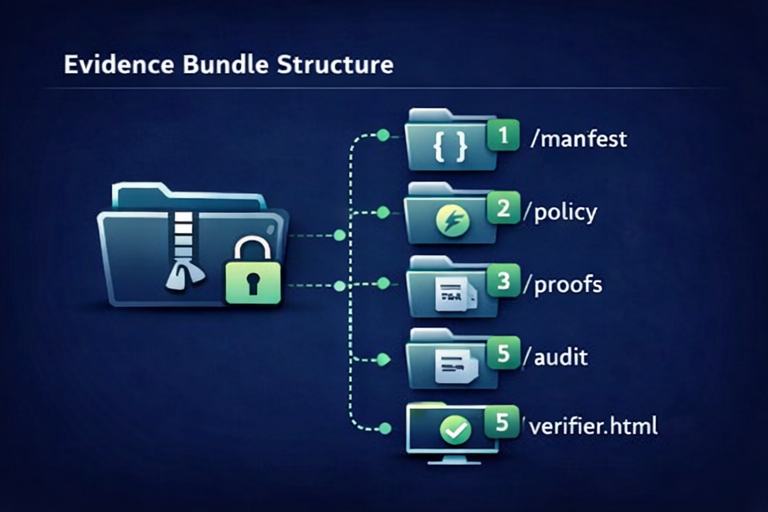
ERF is the structured evidence record format layer, powered by Vraimony. It keeps the same proof path portable, inspectable, and easier to reuse across summary sheet, proof card, structured bundle, structured data export (JSON / ERF), and a read-only verification path.
ERF turns ordinary records into portable, review-ready evidence outputs.
ERF is an open, structured format for evidence records that makes documentation clearer, verification easier, and reuse possible — without tracking and without lock-in.
A reviewer-facing summary that keeps the package easier to understand at a glance.
A compact handoff object that makes the proof path easier to identify and share.
A cleaner grouping of operational records, notes, and references for review-ready use.
Portable evidence output, powered by Vraimony ERF.
A bounded inspection path for integrity and reference state after packaging.
ERF should feel understandable to operators, reviewers, and developers. The format story starts from practical output value, not abstract protocol language.
Verification stays bounded. It helps inspect packaged records without turning integrity checks into broader claims about truth, identity, or outcome.
ERF fits naturally beside CSV, JSON, PDF, and PNG where relevant. The point is reuse and inspectability, not trapping the workflow in one closed path.
Structured export makes the data side easier to move, compare, and read inside other systems without pretending Vraimony becomes a giant workflow OS.
ERF works best when record structure changes stay visible, disciplined, and repeatable over time.
The format concept stays independent from any one entry surface. Google Sheets is optional, CSV is portable, and the record path remains replaceable later.
Use a free operational template in Google Sheets or CSV, or begin from an existing record set. Google Sheets is optional.
Use the familiar sheet as the working surface for deliveries, approvals, revisions, or handovers.
Keep the source portable and replaceable. CSV is the canonical portable path.
Use the workflow as a proof-ready input path. This phase does not claim a full automated CSV ingestion engine.
After packaging, the output path can include a summary sheet, proof card, structured bundle, structured data export (JSON / ERF), and a read-only verification path.
Keep the primary packaging path cleaner and more repeatable.
Review a summary-first path instead of reconstructing the story from raw files.
Support escalation, procurement, partner, audit, or insurance review with calmer structured export.
Preserve context for acknowledgement, correction, missing-item follow-up, or dispute response.
The current public path starts on the sender side. Package the record clearly, then share a read-only verification path. The next response can stay simple: received, accepted, correction needed, or missing item.
An open, structured evidence record format layer for packaging, exchange, and bounded verification.
Not an official authority claim, not a certified format, not a legal acceptance mechanism, and not an outcome guarantee.
It signals origin and packaging lineage around the structured output path. It should feel like a calm signature, not exclusivity or lock-in signaling.
Because the output layer should stay easier to inspect, move, and reuse across workflows.
No. ERF is meant to stay open, portable, and technically neutral even when Vraimony powers the packaging story around it.
JSON is the practical structured export surface. ERF gives that output a cleaner evidence-record meaning and packaging discipline.
No. ERF supports clearer packaging and bounded verification, not acceptance, admissibility, or dispute results.
Portable evidence output, powered by Vraimony ERF.